
Bisexuality, masculinity, and the Black urban bodies that don’t fit the script
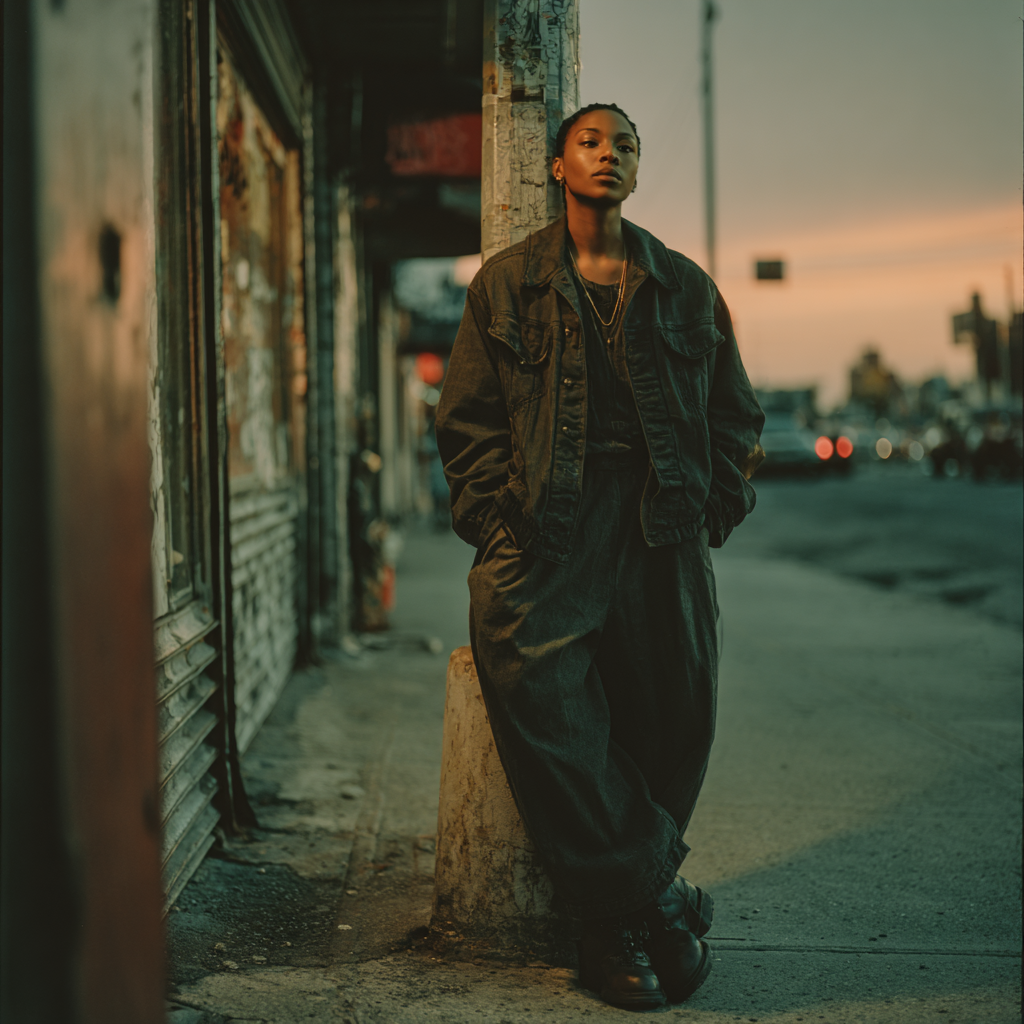
The woman I’m thinking about is standing outside a downtown bar that calls itself “women-centered” and “queer-friendly.” It’s a weeknight, after work. She’s in steel-toe boots, navy dickies, a fitted button-up, and a jacket that reads more warehouse than WeWork. Fade sharp, eyebrows natural, no visible makeup. She’s texting, leaning into the wall like it belongs to her.
A couple walks past—heels, curls, a soft cardigan draped over one of their shoulders. One of them glances up, clocks the boots, the stance, the broadness in her shoulders, and does that quick internal math:
lesbian, stud, masc.
What nobody in that doorway knows—unless she says it out loud—is that she’s bi.
This is the figure I keep returning to when I think about “bi masculine lesbians”: women in the African diaspora who move through urban queer and straight spaces with a masculine-of-center posture, are read as lesbians by almost everyone around them, and yet know their desire spills past the boundaries of that category. Their bodies get slotted into a familiar silhouette—“masc,” “stud,” “AG”—while their bisexuality remains invisible, suspect, or strategically unspoken.
The question under this essay is simple and messy:
What happens to bisexual, masculine-of-center Black women when the world insists on seeing them as lesbians, and what does that misrecognition cost them—emotionally, socially, and politically?
Context and Key Concepts: Names for the Borderlands
To even name this figure, we have to borrow language from different places: bisexuality, masculinity, lesbian communities, Black feminist thought, and queer of color critique.
Bisexuality, in contemporary research, is often defined as attraction to more than one gender—sometimes called “plurisexuality” to emphasize the multiplicity of gendered desire (Mitchell et al. 2–3). Bisexual people make up a large share of the LGBTQ+ population; a 2013 Pew survey found that about 40% of respondents identified as bisexual, and more recent data suggests bisexual identity is especially common among younger women, including Black and Hispanic women (Mitchell et al. 1–3). Yet they remain under-studied and frequently collapsed into “lesbian/gay” categories in research and popular discourse (Mitchell et al. 10–13; Ghabrial and Ross 132–33).
“Masculine of center” (MoC) is a community-born term that names a range of gender expressions clustering around masculinity—often within queer women’s and trans communities of color. Nonbinary Wiki, quoting the grassroots organization BUTCH Voices, notes that MoC was coined by B. Cole of the Brown Boi Project to recognize “the breadth and depth of identity for lesbian/queer/womyn who tilt toward the masculine side of the gender scale” and includes identities such as butch, stud, AG, dom, macha, tomboi, and trans-masculine, among others (“Masculine of Center”). The Brown Boi Project itself describes its community as “masculine of center women, men, two-spirit people, trans people, and our allies committed to changing the way that communities of color talk about gender” (Brown Boi Project).
In Black feminist theory, intersectionality offers a way to understand why MoC bi women of the African diaspora feel so misread. Kimberlé Crenshaw’s foundational work describes how race and gender interact to create forms of discrimination that can’t be understood by looking at either category alone (Crenshaw 140–43). Deborah King expands this into “multiple jeopardy,” noting that racism, sexism, and classism don’t simply add up but multiply, producing specific conditions for Black women’s lives (King 47–49). When sexuality and gender expression are layered onto that—particularly in the context of bisexual identity and masculine presentation—the social math gets even more complex.
Importantly, the phrase “bi masculine lesbians” is not a category used in most academic research. Scholars tend to talk about “bisexual women of color,” “bisexual women and gender diverse people of color,” or “masculine-of-center” identities, often in separate conversations (Ghabrial, “We Can Shapeshift”; Mitchell et al. 12–18; “Masculine of Center”). What I’m naming here sits at their intersection: people who live as bi, read as lesbian, and move through the world in a body that leans masculine—and Black.
Read as Lesbian, Erased as Bi
One of the most consistent threads in research on bisexual people is erasure. Bisexual women are frequently perceived as “actually gay” or “actually straight,” depending on the gender of their current partner (Mitchell et al. 145–52). This “bierasure”—having one’s bisexual identity ignored, denied, or misnamed—shows up both in heterosexual spaces and within LGBTQ+ communities (Mitchell et al. 115–18; Ghabrial and Ross 147–50).
For bi women of color, that erasure is intensified by racialized gender expectations. In a phenomenological study of twelve bisexual women of color, Sarah N. Mitchell and colleagues found that participants described both challenges and positives in living at the intersection of marginalized identities, including racism, biphobia, and stereotypes of hypersexuality applied to women of color (Mitchell et al. 246–70). Some participants reported that their families and communities treated bisexuality as illegitimate or threatening to traditional roles, while others found that even within LGBTQ+ spaces, their bisexuality was dismissed or misunderstood (Mitchell et al. 200–03, 252–57).
Monica Ghabrial’s work on bisexual people of color (BPOC) underscores how deep this invisibility runs. In a content analysis of 324 quantitative studies on bisexual mental health, Ghabrial and Lori Ross found that only 7.4% reported outcome data specifically for BPOC, and just ten studies had samples consisting exclusively of racial/ethnic minorities (Ghabrial and Ross 297–301). In other words, most of what we “know” about bisexual mental health is based on samples that are largely white, and BPOC are often present but analytically invisible.
When a bi woman of the African diaspora presents as masculine-of-center—a stud in a bomber jacket, a MoC office worker in slacks and oxfords—her body becomes legible through scripts people already recognize: “lesbian,” “butch,” “AG.” Research on bisexual stigma shows that bisexual people are often stereotyped as promiscuous, untrustworthy, or “confused,” and sometimes resented for their ability to “pass” as straight (Ghabrial and Ross 68–82; Mitchell et al. 145–49). For a MoC Black woman read as lesbian, the dynamic can invert: in public space and queer venues, her masculinity announces “lesbian” so loudly that her bisexuality disappears. What remains is a body that people project certainty onto—about desire, about politics, about community—whether or not she claims those certainties for herself.
In one Toronto-based study of bisexual women and gender-diverse people of color, participants described feeling invisible and hypervisible at the same time: unseen in their specificity, but overexposed as racialized and queer bodies (Ghabrial, “We Can Shapeshift”). Several spoke of moving through “borderlands,” borrowing Gloria Anzaldúa’s language, where they inhabited multiple communities without being fully claimed by any of them (Ghabrial, “We Can Shapeshift”; Mitchell et al. 333–47). For a bi MoC woman in an urban bar or church basement or subway car, that borderland is not metaphorical; it’s the literal threshold she inhabits between how she knows herself and how others decide to label her.
Masculinity on a Black Woman’s Body
Masculinity is not neutral. On a white cis man in a suit, it reads as competence. On a Black cis woman in a hoodie and Timbs, it can read as threat.
Black feminist thinkers have long noted how Black women’s bodies are disciplined through respectability politics and gendered expectations: to be “feminine enough” to avoid being cast as aggressive, “strong,” or unfeminine, but not so feminine as to be read as frivolous or unserious (Collins 69–71; Crenshaw 149–52). When a Black woman leans into masculinity—through her clothes, her stance, her haircut—she troubles these scripts even further.
In bisexual mental health research, Ghabrial and Ross note that BPOC often face unique cultural gender role expectations from family and community members, and bisexuality may be perceived as especially illegitimate or threatening in many racial/ethnic minority contexts (Ghabrial and Ross 127–33). Some respond by concealing their sexual orientation and presenting in more traditional gender roles to maintain cultural ties (Ghabrial and Ross 135–38). When a Black woman instead chooses—or simply inhabits—a more masculine presentation, she may be read by her community as rejecting not only heteronormativity but also Black femininity itself.
Mitchell and colleagues highlight that bisexual women of color navigate anxiety around coming out, fear of losing familial support, and the pressure to avoid confirming stereotypes of hypersexuality or deviance (Mitchell et al. 200–03, 267–70). A masculine-of-center posture can compound those fears. In many urban African diaspora communities, masculine Black women are assumed to be lesbians before they ever open their mouths. Bisexuality, if disclosed, can be dismissed as “a phase” or misread as evidence of promiscuity (Mitchell et al. 145–49). The label “lesbian,” in this context, becomes both shield and straightjacket: safer than naming bisexuality in some spaces, more constraining in others.
Within LGBTQ+ communities, masculinity on a woman’s body carries its own expectations. Autostraddle’s Masculine-of-Center Roundtable, featuring a range of MoC and stud-identified people, describes the constant negotiation between embodying masculinity and resisting patriarchal behaviors, especially for people of color in queer scenes (“Masculine-of-Center Roundtable”). When that MoC person is also bi, they may find that their attraction to men—or to nonbinary people read as masculine—complicates the unspoken script: stud = lesbian = not interested in men, ever. The result can be a form of policing from within queer communities themselves, where bi MoC women are treated as suspect, “less queer,” or not fully loyal.
Urban Borderlands: The City as Sorting Machine
Cities are sorting machines. On the sidewalk, in the train car, at the after-work happy hour, bodies are constantly scanned and categorized: safe, suspect, straight, gay, “family,” not “family.” For Black bi MoC women, that sorting process is relentless.
Mitchell et al. note that bisexual women of color often experience life as a series of “in-between spaces,” where their identities are simultaneously challenged and affirmed (Mitchell et al. 13–20, 246–47). Ghabrial’s qualitative research similarly emphasizes that queer and bi people of color often describe “shapeshifting” between contexts—work, family, queer nightlife—as a survival skill, even as it can take a psychological toll (Ghabrial, “We Can Shapeshift”). In urban environments, that shapeshifting is not hypothetical; it is hour by hour.
Imagine a day in the life of a Black bi MoC woman in a North American city:
At work, in a corporate hallway, her tailored slacks and button-up might read as “professional,” but her close-cropped hair and low voice mark her as just masculine enough to be rumored about. Colleagues may assume she’s a lesbian, pair her with the one out gay coworker at pride-related events, and treat any mention of a male partner as a surprise, a contradiction, or a joke. Her bisexuality becomes something she either has to insist on—risking being seen as oversharing—or quietly let others mislabel.
On public transit, her stance—feet planted wide, shoulders open, backpack slung low—aligns more with how we’re taught to read men’s bodies. Mitchell’s work notes that gender nonconforming presentation coupled with bisexual identity can intensify invisibility and misrecognition (Mitchell et al. 231–34). Passengers may move around her as if she is a buffer, a kind of unofficial security presence, or they may stare with the particular curiosity reserved for Black women who do not soften.
In queer nightlife, her body might finally be recognized as “one of us,” but the “us” is often assumed to be lesbian, not bi. Ghabrial and Ross point out that participation in LGBTQ+ spaces can sometimes worsen the impact of heterosexism for LGBTQ+ people of color, because those spaces remain structured by whiteness and monosexist norms (Ghabrial and Ross 100–107). A MoC Black woman whose flirtation crosses gender lines—dancing with a femme one week and texting a man the next—can be read as disloyal, “messy,” or not truly committed to queer community.
Across these settings, “lesbian” functions as a public shorthand while “bi” remains a careful disclosure, a private truth, or a battleground. The city becomes a borderland, not just between neighborhoods but between readings of her body: corporate asset, public threat, queer kin, suspicious bi.
Critical Reflection: What the Research Misses
For all this texture, the existing research record is thinner than it should be when it comes to bi masculine-of-center women of the African diaspora in urban spaces.
Ghabrial and Ross’s content analysis is blunt: out of 324 studies on bisexual mental health, only 24 reported outcome data separately for bisexual people of color (Ghabrial and Ross 297–301). Mitchell et al. emphasize that while bisexual individuals are often included in LGBTQ+ samples, their experiences—especially as women of color—are rarely disaggregated or centered (Mitchell et al. 10–13). In other words, the women this essay is concerned with are statistically present but analytically ghosted.
Even within this small body of work, most studies focus on internal experiences—identity formation, disclosure, mental health—rather than the embodied, spatial experiences of moving through specific urban environments. We know relatively little, in systematic terms, about how a MoC bi Black woman is read in a Harlem barbershop versus a London Tube carriage versus a Johannesburg taxi rank, even though all of those spaces are shaped by race, class, colonial histories, and local gender politics.
There is also a conceptual gap. “Masculine-of-center” is a community term with deep roots in queer communities of color, but it is only beginning to show up in academic writing, and often in small qualitative samples (“Masculine of Center”; Brown Boi Project; “Masculine-of-Center Roundtable”). Bisexuality, meanwhile, is frequently treated as a static identity label rather than a lived orientation that can look very different across cultural contexts, life stages, and relationship histories (Mitchell et al. 90–98). The specific combination—bi + MoC + Black + urban—is seldom named outright.
Black queer feminist work has given us tools—intersectionality, multiple consciousness, borderlands—to analyze these lives (Crenshaw 139–43; King 47–49; Collins 69–71). But much of that work has historically centered lesbians and gay men, or treated bisexuality as a subset of “gay and lesbian” experience rather than its own terrain (Ghabrial and Ross 147–50). Bi masculine-of-center women fall into a triple shadow: not straight enough for mainstream Black respectability, not femme enough for some narratives of Black womanhood, and not “gold star lesbian” enough for certain queer myths of purity.
Conclusion: Refusing to Choose Between Edges
When I return to that woman outside the bar—boots planted, shoulders easy, phone in hand—the question I keep circling is not “What is she really?” but “What do we lose when our frameworks can’t hold her?”
Research on bisexual women of color tells us that the costs of invisibility are real: elevated rates of depression and anxiety, more complex disclosure decisions, experiences of biphobia and monosexism from both straight and LGBTQ+ communities (Mitchell et al. 145–52; Ghabrial and Ross 66–82, 147–50). Work on BPOC warns that when health research and policy ignore the intersections of race, gender, and sexuality, the most marginalized are left without targeted support or even basic recognition (Ghabrial and Ross 147–52; Mitchell et al. 239–43). Community-based projects like the Brown Boi Project show how powerful it can be when masculine-of-center people of color have language and space to define themselves on their own terms (Brown Boi Project; “Masculine-of-Center Roundtable”).
Bi masculine-of-center women in the African diaspora sit at the convergence of all of this. Their lives are case studies in what Crenshaw calls the “demarginalizing” work of intersectional analysis: paying attention to the people who fall through the cracks of single-issue movements and single-axis research (Crenshaw 139–40). Their bodies, in city streets and subway cars and office corridors, quietly test our assumptions about what “lesbian,” “bi,” “masculine,” and “Black woman” are allowed to look like.
Two takeaways emerge from the research and from the lived realities it gestures toward. First, scholarship and policy need to stop treating bisexuality and masculine-of-center identities as afterthoughts. Studies that explicitly recruit bi women of color, including those who identify as MoC or stud, and that analyze their experiences separately rather than folding them into broader categories, are crucial. Second, qualitative, place-based work—what happens on that sidewalk, at that bar, in that salon—matters as much as large-scale surveys. It’s in those everyday spaces that labels harden into stereotypes or soften into conversation.
The bi MoC woman outside the bar doesn’t owe anyone an explanation of her desire. But our research, our activism, and our storytelling owe her something: the dignity of accuracy. A framework wide enough for her boots, her stance, her borderland heart.
Works Cited
Brown Boi Project. The Brown Boi Project. Brown Boi Project, www.brownboiproject.org.
Collins, Patricia Hill. Black Feminist Thought: Knowledge, Consciousness, and the Politics of Empowerment. Routledge, 2000.
Crenshaw, Kimberlé. “Demarginalizing the Intersection of Race and Sex: A Black Feminist Critique of Antidiscrimination Doctrine, Feminist Theory and Antiracist Politics.” University of Chicago Legal Forum, vol. 1989, no. 1, 1989, pp. 139–67.
Ghabrial, Monica A. “‘We Can Shapeshift and Build Bridges’: Bisexual Women and Gender Diverse People of Color on Invisibility and Embracing the Borderlands.” Journal of Bisexuality, vol. 19, no. 2, 2019, pp. 169–97, doi:10.1080/15299716.2019.1617526.
Ghabrial, Monica A., and Lori E. Ross. “Representation and Erasure of Bisexual People of Color: A Content Analysis of Quantitative Bisexual Mental Health Research.” Psychology of Sexual Orientation and Gender Diversity, vol. 5, no. 2, 2018, pp. 132–42.
King, Deborah K. “Multiple Jeopardy, Multiple Consciousness: The Context of a Black Feminist Ideology.” Signs: Journal of Women in Culture and Society, vol. 14, no. 1, 1988, pp. 42–72.
“Masculine of Center.” Nonbinary Wiki, 17 July 2023, nonbinary.wiki/wiki/Masculine_of_center.
“Masculine-of-Center Roundtable: How We Do It and What It Means to Us.” Autostraddle, www.autostraddle.com/masculine-of-center-roundtable-how-we-do-it-and-what-it-means-to-us.
Mitchell, Sarah N., et al. “‘The In-Between Spaces of Those Labels’: Exploring the Challenges and Positives of Being a Bisexual Woman of Color.” Global Journal of Human-Social Science: Sociology & Culture, vol. 23, no. 3, 2023, pp. 1–17, globaljournals.org/GJHSS_Volume23/3-The-In-Between-Spaces.pdf.
0 Comments