
Subtitle: Studs, Femmes, and the Scripts We Inherit in Urban Diaspora Life
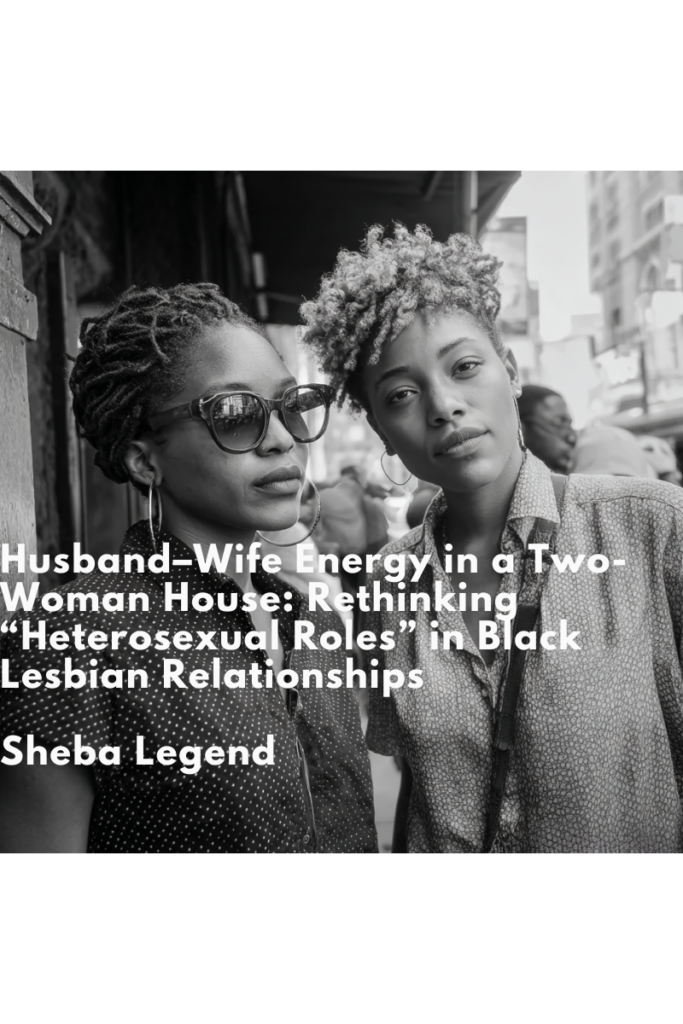
On certain days in the city, you can feel the choreography of couples before you ever hear their conversations. The way one partner instinctively walks street-side and the other tucks in toward the buildings. Who pulls out the MetroCard. Who orders at the counter while the other scans for an open table. For Black women in same-sex relationships, especially in dense urban spaces where bodies are constantly read and misread, these tiny habits get interpreted as something bigger: Who’s “the man”? Who’s “the woman”?
It is an old question with stubborn staying power. But inside Black lesbian and queer communities, the answer is more complicated than “one of each.”
This essay asks a simple but loaded question: what does it really mean to talk about “heterosexual roles” in lesbian relationships, especially among African diaspora women in cities like New York, London, or Johannesburg? And how do configurations like femme + masc, femme + femme, and masc + masc actually function once we step beyond the easy shorthand of “husband and wife” and into the lived interior of Black queer life?
My argument is this: Black lesbian relationships sometimes draw from heterosexual gender scripts, especially in stud–femme pairings, but they also rewrite, fracture, and refuse those scripts in ways that reflect the racialized histories of Black womanhood. When we pay attention to what happens inside Black urban life, “roles” stop looking like a simple copy of straight relationships and start looking like a negotiation among culture, survival, and desire.
Context and Key Concepts: Doing Gender, Doing “Husband and Wife”
Sociologists Candace West and Don Zimmerman famously described gender as something we “do” in everyday interaction—a “routine accomplishment” that makes categories like “woman” and “man” seem natural even though they’re constantly being performed and judged in context (West and Zimmerman). Their concept of “doing gender” helps explain why, even when there is no man in the room, people still want to know who is acting “like” one.
In Black lesbian communities in U.S. cities, those performances often crystallize around roles like stud and femme. Drawing on ethnographic work in New York’s Black lesbian scene, Mignon R. Moore shows how gender presentation, Timberlands and fitted caps versus lipstick and heels organizes expectations around who pays the bills, who initiates sex, who is expected to be emotionally “soft,” and who is allowed to be emotionally guarded (Moore, “Lipstick or Timberlands?”. Black queer communities have also developed umbrella terms like “masculine of center,” coined by activist B. Cole and popularized through the Brown Boi Project, to describe people (often of color) who tilt toward masculine expressions across identities such as stud, butch, AG, and transmasculine (Cole; “Masculine of Center”).
On the surface, it is easy to say that stud–femme couples map onto heterosexual husband–wife roles. But Moore’s broader research on Black lesbian families shows something more layered. She finds that Black lesbian couples often share economic and domestic responsibilities more equally than straight couples, even when one partner presents in a more masculine way (Moore, Invisible Families; “Two Sides of the Same Coin”). At the same time, partners still talk about “who’s the man” under pressure from families and communities steeped in heteronormative ideas of respectability.
Meanwhile, quantitative research on same-sex couples, often not race-specific, repeatedly shows that lesbian couples divide household labor more equally than heterosexual couples, even when one woman is more feminine and the other more masculine (Kurdek; Goldberg, Smith, and Perry-Jenkins). So the stereotype that lesbian relationships simply copy heterosexual gender roles does not hold neatly at the level of chores and paychecks. Where it persists is in language, expectations, and the gaze of others.
For African diaspora women in urban spaces, from Brooklyn walk-ups to Brixton flats and townships on the outskirts of Johannesburg, the question of who counts as “the man” intersects with histories of racialized labor, migration, and Black women’s longstanding roles as both caregivers and breadwinners (Collins; Moore, “Two Sides of the Same Coin”). The “heterosexual roles” conversation, in other words, is never just about gender. It is also about race, class, and the city.
Stud + Femme: Borrowing the Script, Flipping the Ending
In Black lesbian communities, particularly in the U.S., stud–femme pairings are often read as the default couple form. Studs—masculine-presenting women or masculine-of-center people, often Black—are associated with protectiveness, control of public space, and sometimes financial responsibility. Femmes are expected to embody visible femininity and emotional expressiveness (Moore, “Lipstick or Timberlands?”; Wilson).
Bianca D. M. Wilson argues that these identities are not simply copies of white butch–femme roles but are deeply shaped by Black cultural understandings of masculinity and femininity, hip-hop aesthetics, and community-specific language (Wilson). In her analysis of Black lesbian gender culture, Wilson shows how studs draw on familiar images of Black masculinity, rappers, athletes, older neighborhood men—but also face scrutiny for “doing masculinity wrong” when they inhabit it without male bodies or male privilege (Wilson).
Qualitative interviews with Black lesbians in urban U.S. contexts echo this tension. In Maria Valenti’s study of young Black lesbians, participants describe stud–femme relationships in which the stud is “supposed” to take on roles like fixer, protector, and sometimes primary breadwinner, yet the actual financial and emotional labor looks more shared in practice (Valenti). This aligns with broader findings that lesbian couples divide tasks more evenly than heterosexual couples while still narrating their relationships through gendered language (Kurdek; Thorn).
The “heterosexual roles” label shows up most clearly in how others talk about stud–femme pairs. Families may ask who is “the man of the house.” Strangers assume the stud partner is in charge of decisions or money. Religious relatives, especially in immigrant or Southern-rooted Black communities, sometimes rationalize a stud’s presence by slotting her into the category of “honorary man,” treating the femme partner as closer to a traditional wife (Moore, Invisible Families).
Yet inside many of these relationships, the script bends. Moore’s research on Black lesbian stepfamilies shows that decision-making is often mutual and that both partners may contribute substantial income, challenging the assumption that masculinity automatically equals economic dominance (Moore, “Gendered Power Relations”). Some femmes in Wilson’s work explicitly refuse the idea that they are “weaker” or “subordinate,” framing their femininity as powerful, strategic, and central to the couple’s social survival (Wilson).
In other words, stud–femme pairings among African diaspora women in cities often look like remix projects: familiar “husband–wife” imagery at the surface, but underneath, a more negotiated, queer division of power, resources, and care.
Femme + Femme: Softness, Visibility, and the Question of “Who’s in Charge?”
Femme–femme relationships disrupt the easiest version of the heterosexual-roles story by refusing a legible “man.” Two femmes on a Harlem sidewalk or in a South London café may be read as friends, sisters, or co-workers long before they are recognized as partners. That misrecognition shapes both their safety and their power.
There is less research specifically focused on Black femme–femme couples, but existing studies on lesbian relationships and gender presentation offer some clues. Moore notes that in Black lesbian communities, femmes are sometimes viewed as “less gay” or less committed when paired with each other, precisely because they lack a visibly masculine partner to stabilize their queer identity in the public eye (Moore, “Lipstick or Timberlands?”). That invisibility can protect, passing as straight in hostile environments, but it can also erase, especially for women of color whose sexuality is already overpoliced and underacknowledged (Collins).
At the level of daily life, studies of lesbian couples suggest that when both partners present as feminine, the division of labor often rests less on gendered assumptions and more on practical factors like work schedules, income, and personal preference (Goldberg, Smith, and Perry-Jenkins; Kurdek). Valenti’s dissertation reports that some Black femme participants in femme–femme relationships explicitly framed their partnership as “teamwork,” emphasizing mutual support and a rejection of “one dominant, one submissive” roles (Valenti).
In urban diaspora contexts, femme–femme couples also navigate racialized stereotypes of Black womanhood. Patricia Hill Collins describes how controlling images—like the hypersexual Jezebel or the self-sacrificing “strong Black woman”, shape how Black women’s bodies are read in public (Collins). For two Black femmes together, these images can collide: their relationship may be fetishized, dismissed, or folded into existing narratives about Black women’s sexuality. The question “Who’s the man?” then becomes not just inaccurate but absurd; the couple’s work is often about carving out space for a relationship that refuses that binary altogether.
Here, heterosexual roles do not neatly map at all. Instead, femme–femme couples expose the limits of heteronormative language. When two Black women in dresses split the rent, co-parent, and protect each other on late-night train rides, the social grammar for “who is who” falters. That failure is instructive.
Masc + Masc: Stud4Stud, Rules, and the Trouble with Mirror Images
If stud–femme pairings get read as familiar and femme–femme couples get rendered invisible, masc–masc relationships, stud + stud, AG + AG, often trigger open policing inside Black lesbian communities themselves.
The documentary The Same Difference: Gender Roles in the Black Lesbian Community showcases this policing vividly. Through interviews with Black masculine-of-center women and their partners, filmmaker Nneka Onuorah documents community rules that label stud–stud relationships as “wrong,” “confusing,” or “too gay,” even as studs are expected to desire femmes in ways that echo heterosexual scripts (Onuorah). Those who date other studs may be accused of betraying community norms or “acting like men” in a way that is seen as excessive or threatening.
Academic work supports the idea that these tensions are not just interpersonal but structural. Wilson notes that Black lesbian masculine identities are shaped by both the desire to escape the vulnerability assigned to Black femininity and the pressure to imitate or resist Black male masculinity, which remains associated with both power and danger (Wilson). When two masculine-of-center partners come together, they complicate the heteronormative fantasy of clear gender complementarity. There is no easy way to assign “the wife” role, and that ambiguity can generate anxiety in communities organized around more stable stud–femme norms.
At the same time, qualitative accounts suggest that masc–masc couples are experimenting with alternatives to traditional roles. Valenti and Riley both include participants who describe stud–stud relationships where intimacy is grounded in shared understanding of gendered vulnerability—how it feels to be read as “hard” or “aggressive” in Black urban spaces and where tasks and emotional labor are negotiated rather than assumed (Valenti; Riley). These pairings highlight that masculinity itself is not a fixed position but a set of practices that can be redistributed and softened inside queer relationships.
Rather than mirror heterosexual roles, masc–masc couples often expose how fragile those roles really are. If two masculine-of-center women can cook for each other, be tender with each other, and still walk through the world in Timberlands and hoodies, the equation “masculine = man = dominant provider” starts to fracture.
Evidence Beyond the Couple: Urban Space, Diaspora, and Safety
For African diaspora women in cities, relationship roles are never just about who takes out the trash. They are also about who stands closer to the door when a stranger gets loud on the train, who deals with landlords or police, who is more likely to be stopped, surveilled, or harassed.
Research on queer women navigating urban environments in South Africa, for example, highlights how Black lesbians use clothing, posture, and partnership dynamics to manage risk in public spaces marked by homophobia and misogyny (Khuzwayo). Those who present more masculinely may absorb more attention or threat, functioning as a kind of shield for their partners, sometimes by choice, sometimes by expectation. Similar patterns appear informally in North American cities, where masculine-of-center Black women report being treated as security, bouncers, or “the man of the group” regardless of their actual role in a relationship (Moore, “Lipstick or Timberlands?”; Wilson).
In this context, what gets called “heterosexual roles” is often a survival strategy stitched out of unequal terrain. The partner who steps forward with the building super, who walks street-side, who watches the door in a bar is not necessarily “the husband” in some domestic, 1950s sense. She may simply be the one whose body the world already reads as armor.
At home, the same couple might divide finances evenly, share childcare with extended kin, and resist any idea that one partner is “head of household” in the patriarchal sense (Moore, Invisible Families). The relationship, then, cannot be understood without looking at how race, gender, and space converge outside the front door.
Critical Reflections: Gaps, Silences, and the Limits of Our Language
There are important limits in the research we have. Much of the empirical work on same-sex couple dynamics has focused on largely white, middle-class samples, with race mentioned only as a demographic variable (Kurdek; Goldberg, Smith, and Perry-Jenkins). Studies that center Black lesbians—like Moore’s and Wilson’s, offer rich qualitative depth but are still relatively few compared to the scale of Black queer life across the diaspora. Femme–femme and masc–masc pairings among Black women are especially under-documented in scholarly literature, often appearing instead in documentaries, anthologies, or community-based storytelling (Onuorah; Smith).
There are also tensions in how “roles” are framed. Some scholars argue that talking about heterosexual roles in lesbian relationships risks re-centering heterosexuality as the norm against which everything else is measured (Collins; Ferguson). Others suggest that ignoring those echoes erases the very real ways queer people repurpose, resist, or are constrained by heteronormative expectations (Moore, “Two Sides of the Same Coin”). Both perspectives matter.
For African diaspora women in urban spaces, the language question is not theoretical. It shows up when a partner is introduced to family as “like the man,” when a femme is told she is “too pretty to be gay,” or when masc–masc couples are policed as “doing too much.” These moments reveal that the heterosexual script is still in the room, even when everyone present knows there is no husband coming through the door.
Conclusion: Beyond “Who’s the Man?”
So what do we really see when we look at heterosexual roles in Black lesbian relationships?
In stud–femme couples, we find echoes of husband–wife scripts, especially in how outsiders assign authority and responsibility, but research shows that many of these couples organize money, childcare, and household work in more egalitarian ways than their straight counterparts (Moore, Invisible Families; Kurdek). In femme–femme pairings, the hetero script struggles to latch on at all, producing both invisibility and a form of quiet resistance. Masc–masc relationships, meanwhile, challenge the community’s own attachment to complementary roles, highlighting that Black queer masculinities can be tender, reciprocal, and not easily mapped onto “the man” at all (Wilson; Onuorah).
Across all three configurations, the lives of African diaspora women in cities like New York, Johannesburg, and London reveal that what gets called “heterosexual roles” is often a rough translation—sometimes useful, often misleading. It can describe certain patterns of protection, decision-making, and symbolic masculinity, but it cannot capture the full complexity of how Black queer women share power, pleasure, and responsibility in their homes and on their streets.
Two questions linger for future research and for those of us who care about naming these dynamics accurately:
First, how might our understanding of Black lesbian relationships shift if we stopped asking “Who’s the man?” and instead asked, “How do race, gender, and space shape who gets to feel safe, soft, or seen in this partnership?”
Second, what new language might emerge if we took seriously studs, femmes, stemmes, and unlabeled Black queer women as theorists of their own lives, people whose stories, not just their categories, should anchor how we talk about roles, love, and power?
Until scholarly research fully catches up, the most honest answer might be this: in many two-woman houses, there is no husband. There are, instead, two people making do with the scripts they inherited, the bodies they inhabit, and the worlds that read them, writing something queerer, and often more egalitarian, in the process.
Works Cited
Chan, Raymond W., et al. “Division of Labor Among Lesbian and Heterosexual Parents: Associations with Children’s Adjustment.” Journal of Family Psychology, vol. 12, no. 3, 1998, pp. 402–419.
Collins, Patricia Hill. Black Sexual Politics: African Americans, Gender, and the New Racism. Routledge, 2004.
Cole, B. “Founding of the Brown Boi Project.” Brown Boi Nation, 2010, brownboination.wordpress.com/founding-of-the-brown-boi-project/.
Goldberg, Abbie E., JuliAnna Z. Smith, and Maureen Perry-Jenkins. “The Division of Labor in Lesbian, Gay, and Heterosexual New Adoptive Parents.” Journal of Marriage and Family, vol. 74, no. 4, 2012, pp. 812–828.
Khuzwayo, Fareeda. “Navigating Urban Spaces as Queer Women in South Africa.” Urban Forum, vol. 31, no. 4, 2020, pp. 499–516.
Kurdek, Lawrence A. “What Do We Know About Gay and Lesbian Couples?” Current Directions in Psychological Science, vol. 13, no. 5, 2004, pp. 251–254.
“Masculine of Center.” Wikipedia, Wikimedia Foundation, last updated 2025, en.wikipedia.org/wiki/Masculine_of_center.
Moore, Mignon R. Invisible Families: Gay Identities, Relationships, and Motherhood among Black Women. University of California Press, 2011.
---. “Lipstick or Timberlands? Meanings of Gender Presentation in Black Lesbian Communities.” Signs: Journal of Women in Culture and Society, vol. 32, no. 1, 2006, pp. 113–139.
---. “Two Sides of the Same Coin: Revising Analyses of Lesbian Sexuality and Family Formation Through the Study of Black Women.” Journal of Lesbian Studies, vol. 15, no. 1, 2011, pp. 58–68.
Onuorah, Nneka, director. The Same Difference: Gender Roles in the Black Lesbian Community. The Same Difference Film, 2015.
Thorn, Erin D. Division of Labor in Lesbian Households. Lehigh University, Undergraduate Thesis, 2010.
Valenti, Maria. Lesbian Gender Identity Development and Gender Roles of Young Black Women. Michigan State University, PhD Dissertation, 2011.
West, Candace, and Don H. Zimmerman. “Doing Gender.” Gender & Society, vol. 1, no. 2, 1987, pp. 125–151.
Wilson, Bianca D. M. “Black Lesbian Gender and Sexual Culture: Celebration and Resistance.” In Lesbian Communities: Festivals, RVs, and the Internet, edited by Esther D. Rothblum and Kathleen A. Brehony, Harrington Park Press, 1999, pp. 73–96.
0 Comments